


“Editorials” usually refer to an article or a piece of media reflecting the author’s opinions. However, this word has taken on a new meaning in the fashion industry. Editorials, referring to story-driven, artistic photographs that provide a narrative or theme, rather than just promoting products, were pioneered by fashion powerhouses like Harper’s Bazaar and Vogue since the 1900s. The “editorial” has since made its mark on magazines and become a key part of what we know as fashion. Many young creatives have now taken on this medium of photography and imaging, though often overshadowed by giants who have decades of experience in the field of editorials. Oftentimes, the most visible form of an editorial is on magazine covers, a platform where one notable creative has staked her claim: Anna Wintour.
Wintour’s famous 1988 debut Vogue cover was an editorial featuring a model in stone-washed Guess jeans, a first for the magazine. Creating this newfound trend of “high-low,” mixing accessible fashion with high-end fashion, Wintour was credited with changing a traditional, conservative fashion magazine into a contemporary leader in the media space. After 37 years as American Vogue’s editor-in-chief, Wintour stepped down from the role in June 2025. As a longtime figure in the industry, many people were sad to see her go, but many felt that it was time for a change. Indeed, there was a lot of criticism towards her last few Vogue covers, especially when contrasted with her revolutionary start at Vogue. Although accredited with industry-changing work, “innovative” or “ultramodern” are hardly words anyone would use to describe some of Vogue’s recent creations.
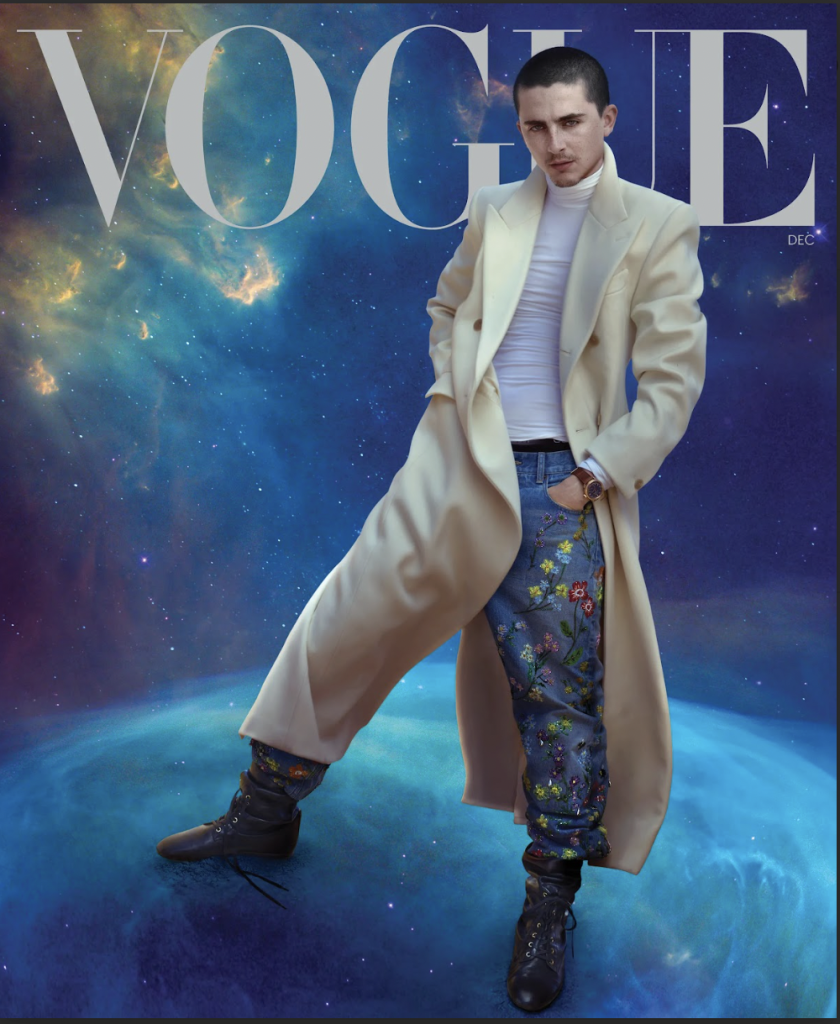
Wintour’s last few covers could very well be described as disappointing or bland; some viewers and critics even said it was her final blow to the magazine after her so-called “dictatorship” at the magazine. One of the aforementioned disappointing covers was actor Timotheé Chalamet, standing atop a nebula, uniformed in head-to-toe Celine, a French luxury house. Titled “The Universe According to Timotheé,” this cover is representative of the fashion magazine climate recently: dull and uninteresting. The styling wasn’t particularly visionary, and the backdrop was taken too literally for the article. Many noted that on a technical level, the cover was poorly edited; generally, the cover was not well received.

Another criticised cover was Emma Stone’s September cover, “The Weird and Wonderful World of Emma Stone”. As a fan of Wintour, I was disappointed with the lack of thought, especially for her final cover. Although other shots in the article could have made a compelling cover, somehow the least visually engaging portrait was chosen. This, frankly, marked the long-overdue departure of Wintour, as she no longer brought the vogue to Vogue.
I took this as a sign to turn my head to younger, newer magazines and creatives—after all, who is to pave the way for the youth if not the youth themselves?
A notable magazine is Who What Wear, founded in 2006 by former Elle magazine editors Katherine Power and Hillary Kerr. Who What Wear, or “www,” has achieved commercial success since its inception, attracting over 20 million digital monthly visitors.
Its recent January cover features actress Elle Fanning donning brands like Acne Studios, Issey Miyake, and Marc Jacobs. Consistently throughout the shoot, Fanning stands in front of a dusted cobalt blue backdrop, accompanied by larger-than-life props, including forks, cats, and houses. Creatively directed by the talented Szilveszter Makó, known for his theatrical and story-like creative approach, the shoot was a breath of fresh air. Titled “The Wondrous World of Elle Fanning” (ironically, much like the Vogue article previously mentioned), Fanning is atop a table beside a fish that is larger than her; in other photos, she is holding flaming forks and lying on plates. The entire shoot looks straight out of a storybook, complete with dramatic collars and bows.
A creative photographer from Guangzhou, China, 韋欢, or Wei Huan, has recently caught the attention of the fashion world. Wei’s resume is impressive, with work for magazines such as superELLE China, GRAZIA, GQ China, and Vogue China. Vivid colours spill into every shoot that Wei directs; her graphic design background shines through her creative work. Dubbed playful and imaginative by curators across the industry, Wei has already made her mark. One piece I particularly enjoyed from Wei Huan was on the cover of Harper’s Bazaar China in January 2025. In front of a neon green background, supermodel Chu Wong stands with Liberty Spikes– a 70s British punk-rock hairstyle, a toy sword, and a gleaming ribbon shield. Wei’s work fits perfectly with the zeitgeist of the 21st century: saturated, dreamlike, and a tid bit eccentric.

Following this recent development at Vogue, I hope more creatives and enthusiasts are encouraged to turn their heads to different resources to freshen up their palate and to take advantage of the digital age, where legacy magazines no longer define artistry in the fashion industry.
Sources: Who What Wear, Vogue