


The movie Project Hail Mary, which was adapted from the book with the same title by Andy Weir and directed by Christopher Miller, is a movie worth watching. It has action packed scenes, combines complex science-fiction with heartwarming friendship, and has beautiful cinematography.
This movie follows the story of Ryland Grace (Ryan Gosling), a high school teacher and former biologist who wakes up in space after thirteen years under anesthesia. Grace is on a last-resort mission to save the Earth from a microorganism called Astrophage which consumes the sun’s energy, but when he wakes up from anesthesia he doesn’t remember anything about his identity or the mission. Gradually, he gains his memories back, and these memories are portrayed through a series of flashbacks throughout the movie about his life on Earth and at NASA. So, there are two timelines in this film: Grace’s mission in space and his experience working for NASA. While in space, Grace befriends an alien named Rocky, and they work together to find a solution to prevent Astrophage from destroying the stars.
The movie adaptation of Project Hail Mary does a good job balancing the complex science fiction while keeping the audience engaged. Although the book Project Hail Mary provides substantially more in-depth explanations of the physics, chemistry, and engineering behind the events in this story, the movie adaptation gives enough information to viewers to understand the basics of what was happening without making the movie feel boring. I haven’t read the book yet, but I still understood the plot, showing how the producers did an effective job at keeping the right amount of science-fiction.
This film centers around the friendship between Grace and the alien Rocky, which adds another layer to this film. Grace’s and Rocky’s crewmates died while in space, so Grace and Rocky are each other’s only company. These two characters must find ways to communicate and rely on each other after they were alone for so many years, which was vital in saving the stars. The emphasis on Grace and Rocky’s friendship added depth and emotion to the movie that balanced well with the science-fiction and the plot. The original “assembly cut” of this movie was nearly four hours long, so when deleting scenes the producers could’ve made the choice to keep more scenes about the science fiction or made the movie shorter. However, the decision to keep the emphasis on Rocky and Grace’s friendship strengthened the movie overall.
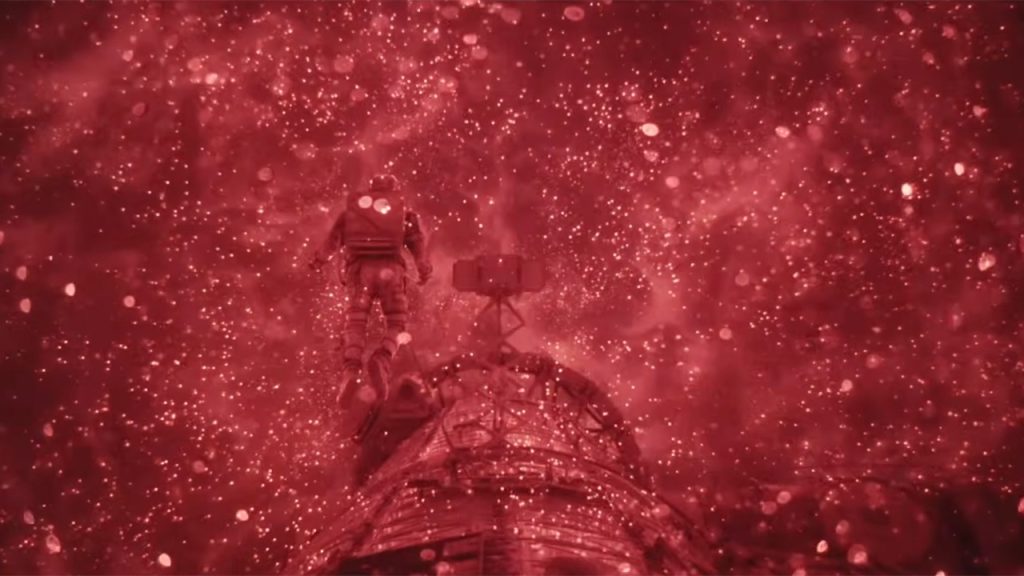
Furthermore, Project Hail Mary has beautiful cinematography that greatly enhances the viewing experience. No green screens or blue screens were used in the production of his movie, according to the director Christopher Miller. Instead, they used full sets, LED screens, and visual effects. The depiction of space in this movie is breathtaking, especially the shots of Grace outside the rocket ship surrounded by Astrophage. Although the Astrophage was causing mass extinction and harm to the stars in the universe, it was still depicted as beautiful in that moment, giving viewers a peaceful moment in an otherwise action packed movie to reflect on the duality of what can seem harmful, for although Astrophage was killing the stars, it was also helping itself survive.

Image source: Cinemablend
Andy Weir also wrote The Martian, which was adapted into a film in 2015. Although these stories have similarities because they are both space-survival stories featuring male scientists, the books have different plots and are not connected to each other.
This film has ranked highly on multiple movie review sites. It earned a 94% on Rotten Tomatoes, with many fans giving extremely positive written reviews.
I would highly recommend watching the movie in theaters, because the large screens greatly enhance the viewer experience because it is easier to appreciate and enjoy the cinematography on the large screen. This movie is two hours and forty minutes long, and tickets are available here.
Image source: Amazon