

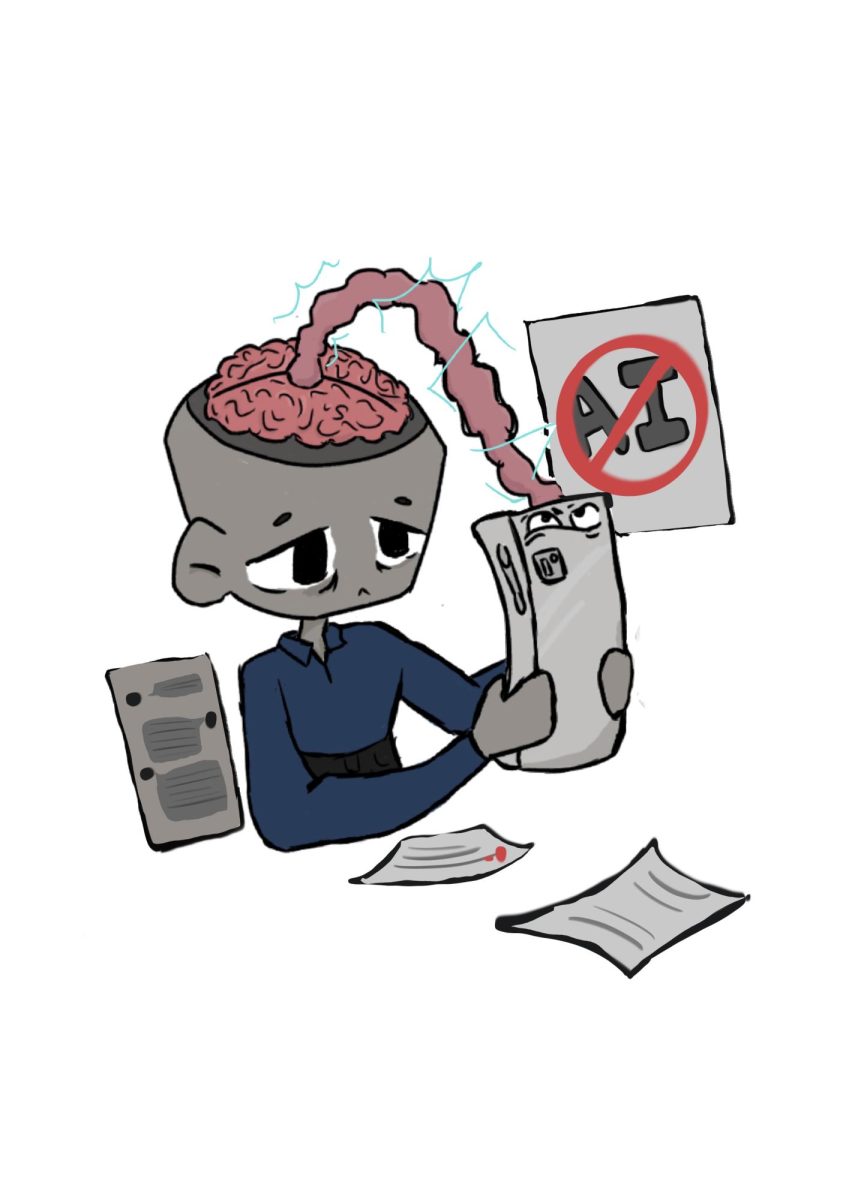
As artificial intelligence continues to develop, its use in educational spaces has become increasingly controversial. The school takes a clear stance against using AI to write assignments or complete work; taking ownership of AI-generated output is plagiarism.
However, the policy around broader AI use is much more ambiguous. According to The Almanac, general policies on AI use in the classroom are “at the discretion of the instructor”; therefore, students encounter a wide variety of teacher perspectives on the issue throughout their Hotchkiss experience.
Some teachers encourage students to use AI or use it themselves for lesson planning, some discourage it but tentatively allow it, and some completely prohibit AI use. In my experience, most teachers, while recognizing that AI chatbots can help in certain situations, believe it ultimately undermines student learning.
However, from a student perspective, widespread student use of AI is no secret. In my experience, most students use AI as a study tool, whether to explain complicated math problems, summarize confusing readings, or to create practice quizzes and problems. While many students don’t use AI when prohibited from doing so, it’s often out of fear of the rules and not because they believe that excessive usage of AI affects their ability to learn.
AI is often perceived as a useful study tool because it can provide immediate explanations tailored to a student’s specific questions—something a regular Google search may not offer and a teacher may not always be available to provide. Yet, that same convenience can undermine learning when students begin relying on AI to do their thinking for them. As Mary Burns and Rebecca Winthrop write for the Brookings Institution, “AI tools prioritize speed and engagement over learning and well-being,” encouraging patterns that “drive cognitive offloading and dependency.” Although using AI may help students earn better grades in the short term, those grades do not necessarily reflect a deeper understanding of the material. When AI replaces the effort of working through a problem, students risk losing opportunities to develop their own critical thinking.
“I want to flip through pages of annotations without knowing that the effort I put into an English paper might be overshadowed by another created with a click of a button.”
When generative AI first became relevant in education, my opinion was initially very negative: like I’ve heard many of my teachers say, I believed it would lessen our abilities to think critically, learn, and create, and I believe humans should stay at the center of creative and educational spaces. However, I’ve come to realize that AI use at a competitive school like ours is much more complicated than I thought.
In my first year at Hotchkiss, I constantly heard my friends on the brink of tears, talking about their ever-growing workloads, harsh pressure from their parents, and expectations never to show signs of struggle. With the constant pressure to succeed, coupled with the feeling that everyone seems to be calling AI the future, I find it harder and harder to judge others for using artificial intelligence.
Yes, I still believe that struggling through difficult material is important to intellectual growth, and relying on AI to do that work can undermine it. But when students associate that struggle with a harsh grade or disappointment from their parents, it becomes easier to understand why they might turn to a chatbot, especially if they believe everyone else is using one and they will fall behind without it. That pressure does not excuse submitting AI-generated work as their own; doing so means compromising their honesty and learning for a better grade. Still, treating this reliance as nothing more than laziness overlooks the expectations that make it so tempting in the first place.
I find myself conflicted about this reality. Although I don’t believe everyone should rely on a chatbot to learn, I’m not naive enough to deny Claude’s impressive ability to quickly summarize Brave New World or the number of times a quick Google AI overview has saved me right before a Spanish quiz—although news regarding negative environmental effects of AI data centers often makes me wish AI was simply less useful. I’ve come to accept that its personalized and straightforward explanations, although flawed, can often be useful for a student struggling in school. On a global scale, it is clear that its influence on the climate of education will only increase in the coming years.
However, I still ultimately believe the widespread reliance on AI chatbots among students at Hotchkiss needs to change. While some students may be unaware of its potential harms, too many ignore them in favor of boosting their grades. This behavior not only hinders their learning experience, but also establishes a dangerous precedent in the approach students take to their education. I’ve seen students who heavily rely on AI mindlessly use it to write anything from essays to emails.
Whenever I catch myself looking to AI for ordinary, solvable problems, I feel the intellectual curiosity and passion that drew me to the school in the first place diminish. This convenient reliance on AI—not only at Hotchkiss, but also across the world—makes me worry for the future of our education.
Somewhat selfishly, I hope generative AI recedes into the background of our lives. I want to learn and struggle through assignments without the thought that I could simply copy-paste my homework into ChatGPT. I want to flip through pages of annotations without knowing that the effort I put into an English paper might be overshadowed by another created with a click of a button. I want to struggle through assignments, and I want to feel like I’m not falling behind by doing so.
However, I know this: I don’t think generative AI will magically disappear from our lives anytime soon. At a school that prides itself on educational depth and fostering curiosity, a greater effort needs to be made to create an environment where students feel less pressure and have less reason to prioritize AI’s convenience. In addition, while there are many measures that punish students when they use AI against school policy, much less attention is paid to the culture that makes it so tempting for students to turn to AI, such as widespread academic pressure, a lack of personalized extra help, and limited leeway for students to make mistakes and learn at their own pace.
 Indresh Chandel