

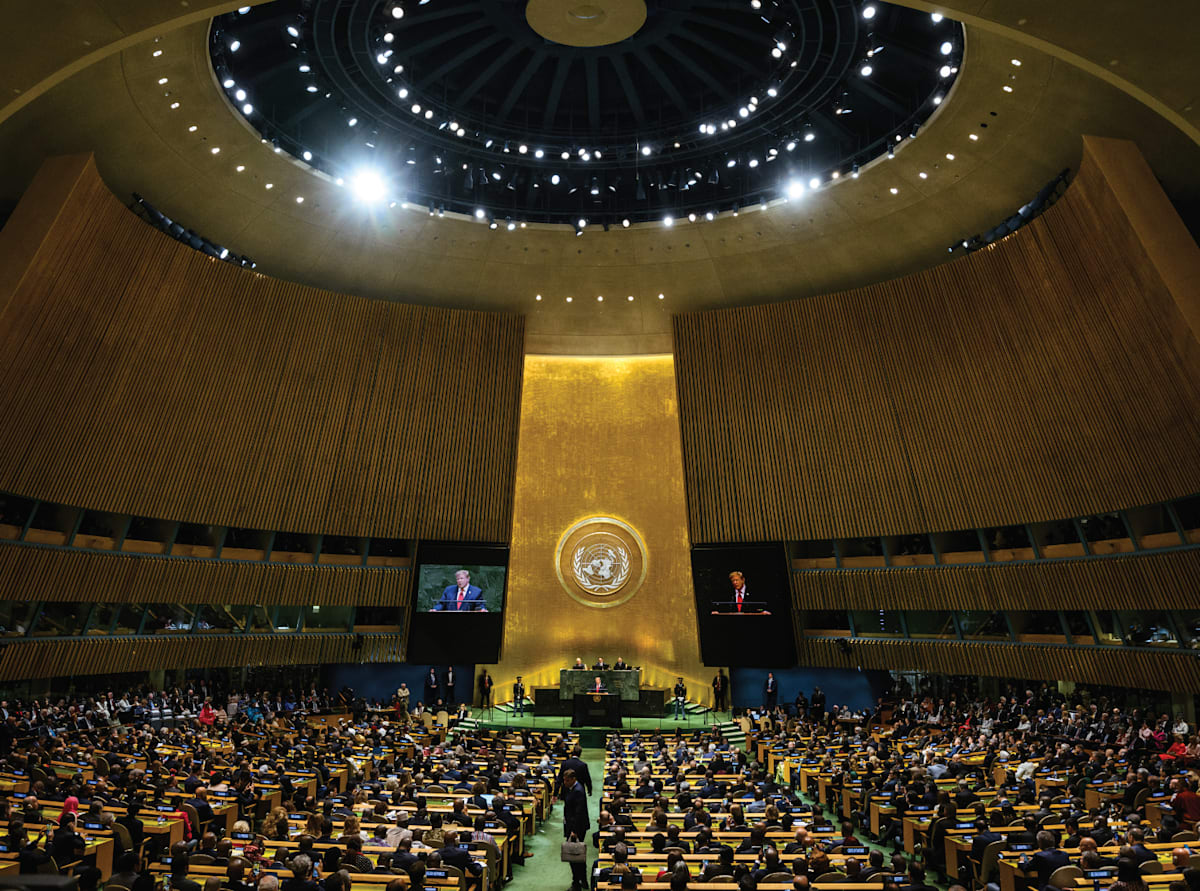
Every year during September, world leaders gather in New York for the United Nations (UN) General Assembly to reach agreements on the world’s most important issues, with topics spanning war, human rights, poverty, and peace. However, after watching this year’s assembly, it is hard not to wonder: do these speeches and diplomatic conversations ever result in measurable change? The General Assembly is a prime example of the UN’s inefficacy in making tangible differences. As leaders discussed conflicts involving the United States and Iran, Israel and Palestine, Ukraine and Russia, along with other major international issues, there was not much done to help people within said conflicts.
The problem is that the same issues continue to be discussed without enough progress to show for it. If world leaders can spend days talking about war, humanitarian crises, and international cooperation but leave without meaningful resolutions, then those discussions lose purpose. The UN should be more than a place for countries to explain their positions; it should be a place where those discussions lead to tangible actions, making a concrete impact for civilians.
The glaring issue is that of the United Nations Security Council. Made up of five nations — China, France, Russia, the United Kingdom, and the United States — each one of these “P5” has the ability to completely veto any resolution made. Clearly, if any proposed resolution falls outside the realms of the P5’s objectives, it won’t pass. This makes the organization feel less like a force capable of changing global circumstances and more like an international forum for discussion, which, although nothing is wrong with it, ought to be treated as such.
The ability to bring countries together is powerful, but communication should be the beginning of action, not the end. The UN can become an easy place to shift responsibility. International organizations can provide assistance, but governments still have to take responsibility for their own countries. If a government is struggling with poverty, corruption, or poor public services, it cannot simply wait for the UN to fix the problem. The UN can provide resources and support, but it cannot address deeply rooted problems within a country’s government on its own.
At the same time, the UN needs to take responsibility for its own shortcomings. It cannot continue to make promises about peace and international cooperation while having a limited ability to enforce them. Consider the Paris Agreement under the United Nations Framework Convention on Climate Change: adopted by 196 nations, the goal was to reduce carbon emissions and global rising temperatures. It was signed in 2015 with eight year intervals between checks. What is the consequence of failing to meet such environmentally significant goals? Nothing.
The UN does not need to solve every conflict in the world; that is obviously unrealistic. However, there does need to be a stronger connection between what happens inside the UN’s meeting rooms and what happens outside them in countries. The United Nations is necessary, but its current approach is not enough. World leaders do not need another meeting to simply acknowledge these problems. They need to use these meetings to create solutions and follow through on them. After this year’s General Assembly, the question should not be whether the UN has something to say; it clearly does, but the question is whether anyone is listening and is willing to take action.
 Indresh Chandel